About IBM Consulting
IBM Consulting is IBM's consulting and global professional services business, with market-leading capabilities in business and technology transformation. It offers strategy, experience, technology, and operations services to many of the most innovative and valuable companies in the world, helping clients bring an open hybrid cloud and AI strategy to life.
Role Details
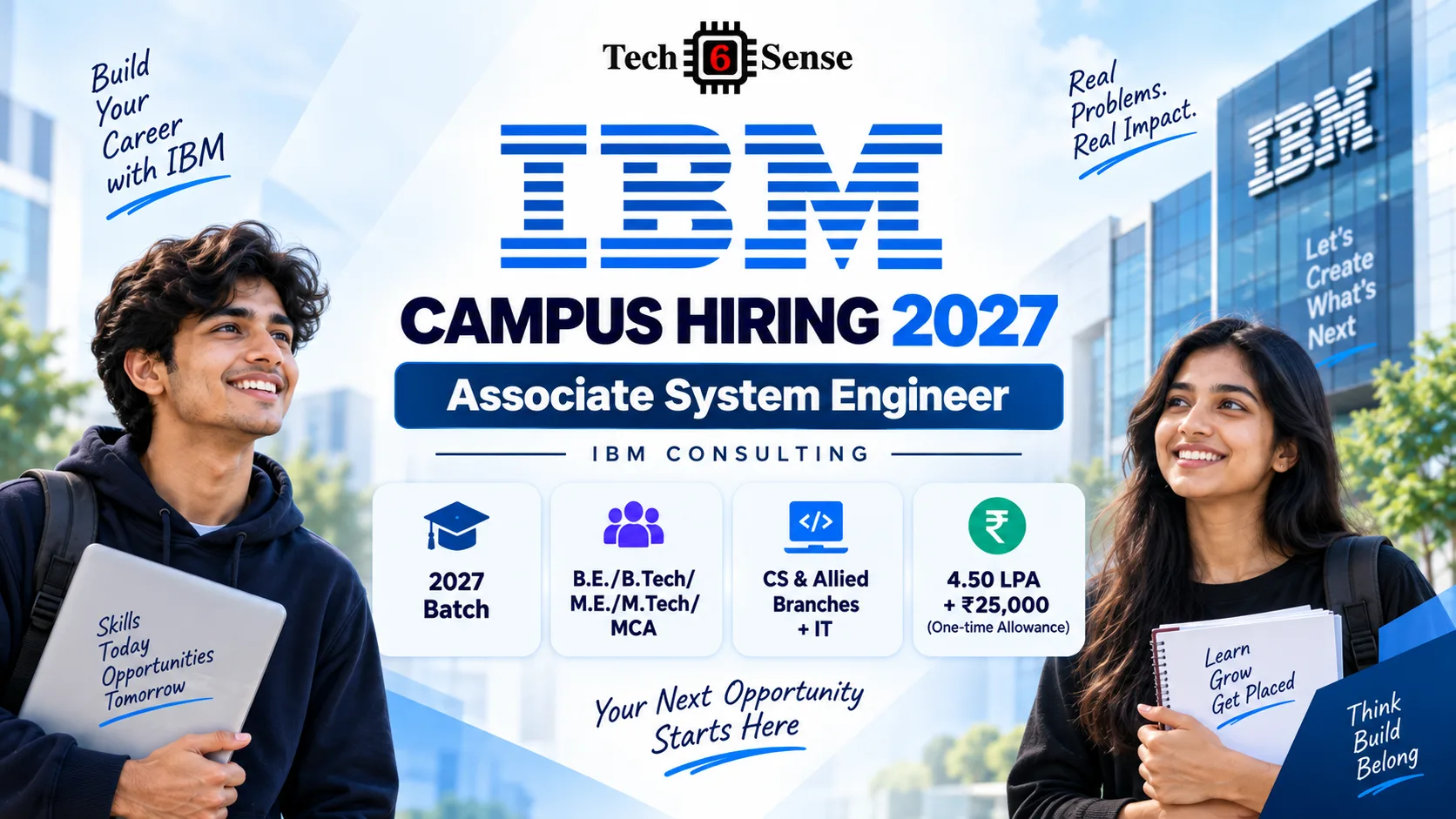
- Company: IBM (IBM Consulting)
- Role: Associate System Engineer
- Batch: 2027 graduating batch only
- Compensation: INR 4.50 LPA + one-time settling allowance of INR 25,000
- Employment: Entry-level, on-campus hiring
Roles & Responsibilities
As a Software Developer you will take part in the full software development lifecycle — design, code implementation, testing, and support — building software that enables clients' hybrid-cloud and AI journeys with high-performing, highly available, responsive, and maintainable applications.
- Analytical problem-solving: analyse, validate, and propose improvements to existing failures with support from the architect and technical leader
- End-to-end engagement: involvement from design and development to testing, release, and troubleshooting, with great customer service
- Stakeholder engagement: drive key discussions with stakeholders and look for opportunities to code creative solutions
Eligibility Criteria
- 2027 graduating batch only
- Degrees: B.E. / B.Tech / M.E. / M.Tech / MCA
- Branches: Computer Science and allied branches (CSE, AIML, DS, Cloud Computing, Big Data Analytics, CSBS, IoT, Robotics, AI, Cybersecurity, Blockchain, etc.) and Information Technology
- Minimum academic score: CGPA 6.0 / 60% and above
- No active backlogs
- Candidates must be in their final year and must obtain their degree before the start of employment with IBM
- Fluent communication skills (written and spoken)
Skills Required
- Programming, preferably in Java, C++, Python, or Node.js
- Software Development Life Cycle (SDLC) concepts
- Engineering background and problem-solving ability
- Good interpersonal skills
- Flexibility to work from anywhere in India
Selection Process
All stages are elimination rounds:
- Coding Assessment 1 (Virtual)
- Coding Assessment 2 (In-Person)
- Knockri Assessment — behavioural & competency assessment (In-Person)
- SHL Spoken English Assessment (In-Person)
- Interviews (In-Person)
The Pre-Placement Talk schedule will be shared shortly by IBM / your placement cell.
Work Locations
Mysore, Ahmedabad, Coimbatore, Lucknow, Hyderabad, Kolkata, Mumbai, Pune, Gurgaon, Chennai, Noida, Visakhapatnam, Navi Mumbai, Bangalore, Kochi, Bhubaneswar, and New Delhi.
Round-wise Preparation Guide
Every round is an elimination round, so treat each one as the final. Here is what each stage looks like and how to prepare for it.
Round 1: Coding Assessment 1 (Virtual, proctored)
What to expect:
- A short, webcam-proctored online coding test taken from your own laptop through an assessment link (commonly on HackerRank)
- A small set of Data Structures & Algorithms problems in a tight time window (candidates commonly report around 30 minutes)
- Problems are usually easy-to-medium: arrays, strings, hashing, sorting, searching, basic recursion and sliding window
- Hidden test cases decide your score; the logic and originality of your solution matter more than the number of problems attempted
How to prepare:
- Solve easy-to-medium DSA problems daily against a timer; about 15 minutes per problem is a good benchmark
- Pick one language (Java, C++, Python or Node.js) and know its syntax and standard library well, since there is no time to look things up
- Practise reading input from STDIN and printing the exact output format, as many failures come from I/O mistakes
- Always test edge cases before submitting: empty input, a single element, duplicates, negative numbers and very large values
Round 2: Coding Assessment 2 (In-person)
What to expect:
- A coding test taken at the venue or campus lab under invigilation
- A similar DSA focus, often slightly longer than Round 1, with an emphasis on correct, clean, working code
- Previous year questions include array and window-based problems (for example, the maximum of minimums for every window size)
How to prepare:
- Work through the IBM Coding PYQs PDF below and the Coding Assessment 2 practice sets in our test series
- Practise writing complete programs without auto-complete, since lab machines may have a basic editor
- Revise time and space complexity so you can pick an approach that passes all test cases within the limits
Round 3: Knockri Assessment (Behavioural & competency, in-person)
What to expect:
- An asynchronous video assessment: a question appears on screen and you record your spoken answer on camera, with no live interviewer
- Usually 2 or more questions about yourself, the role and IBM, in around 10 minutes in total
- About 1 minute to prepare and around 3 minutes to answer each question; once recording starts there is no pause or retake
- Knockri scores the content of your answer (the transcript) for competencies such as teamwork, problem solving, adaptability and motivation
How to prepare:
- Prepare 4 to 5 real stories from projects, internships, hackathons or team activities using the STAR method (Situation, Task, Action, Result)
- Be ready for "Why IBM?", "Why this role?", a time you handled a challenge, a time you worked in a team and a time you learned something quickly
- Use the 1-minute prep window to note 3 key points, then answer with a clear beginning, middle and end
- Speak naturally at a steady pace and look at the camera, not at your own preview
Round 4: SHL Spoken English Assessment (AI-scored, in-person)
What to expect:
- An AI-evaluated spoken English test on SHL TalentCentral, around 20 minutes long, with no human examiner
- Typical sections: reading sentences aloud, repeating sentences, listening comprehension answered in one complete sentence, responding to a short dialogue or situation, and open speaking on a topic (about 30 seconds to think and 45 seconds to speak)
- Scored on pronunciation, fluency, grammar and clarity, not on accent
How to prepare:
- Read English passages aloud daily, focusing on clear pronunciation and a steady pace rather than speed
- Practise speaking on random topics for 45 seconds without long pauses or filler words such as "um" and "like"
- In listening questions, answer exactly what is asked in one full sentence without adding extra information
- Speak at a normal volume close to the microphone, and do not start speaking before the recording begins
Round 5: Interviews (Technical + HR, in-person)
What to expect:
- A technical discussion on your resume, projects and core computer science subjects, followed by HR questions
- Common topics: OOP concepts, DBMS and SQL queries, operating system basics, computer network basics, SDLC and Agile, and cloud fundamentals
- You may be asked to write or explain code for a simple problem and walk through your logic
How to prepare:
- Know every line on your resume, especially your major projects: the problem, your role, the tech stack and the challenges
- Revise the OOP pillars, normalisation, joins, basic SQL queries, processes vs threads, and SDLC models
- Read about IBM Consulting, hybrid cloud and AI (watsonx), and be ready to explain why you want to join IBM
- If you do not know an answer, say so honestly and explain how you would find it; confirm that you are flexible to relocate anywhere in India
Exam Rules & Proctoring Guidelines
Read carefully. IBM assessments are monitored through webcam, screen and activity tracking, and flagged candidates can be removed from the process.
- Plagiarism is strictly not allowed. Code is checked for similarity against other candidates and public solutions; copied or AI-generated code can lead to immediate disqualification
- Do not move out of the camera frame. Keep your face clearly visible, centred and well lit for the entire test
- No other person should be present or audible in the room during the assessment
- Do not switch tabs, minimise the window or exit full-screen mode. Tab and window changes are logged and may flag or auto-submit your test
- Copy-paste is tracked. Code pasted from outside the test window is recorded in your report
- Mobile phones, smartwatches, earphones, notes and second screens are not allowed unless the invigilator or test instructions explicitly permit them
- Do not use AI tools, chat apps, screen-sharing or remote-access software during the assessment
- Do not talk, whisper or read questions aloud during coding rounds; audio may also be monitored
- Do not share or post questions during or after the test; this breaks the assessment terms and can cancel your candidature
- Any proctoring violation can lead to disqualification from the drive, regardless of your score
Test-Day Checklist
- Use a laptop with a working webcam and microphone, and test both 30 minutes before your slot
- Use a stable internet connection and keep a mobile hotspot ready as a backup for virtual rounds
- Keep your laptop plugged in and close all other applications, browser tabs and notifications
- Sit in a quiet, well-lit room with a plain background, with the light in front of you rather than behind you
- Keep your college ID card and a government photo ID ready, and carry them to every in-person round
- Log in 10 to 15 minutes early and read all on-screen instructions before starting
- For in-person rounds, carry printed copies of your resume and reach the venue before the reporting time
Tips & Tricks to Clear Every Round
- Read the whole problem first. Check the constraints and sample cases before writing any code; they hint at the expected approach
- Get a working solution first, then optimise. A brute-force solution that passes some test cases scores better than an unfinished optimal one
- Manage your time. If you are stuck for more than 5 to 7 minutes, move to the next problem and come back later
- Write your own logic. Use meaningful variable names and your own approach; it helps with both plagiarism checks and interview discussions
- Run custom test cases for edge conditions before the final submit
- In Knockri and SHL, speak clearly and completely. Short, silent or off-topic answers score poorly, so use most of the time given
- Stay composed on camera. Sit upright, look at the camera and avoid repeatedly looking away, which can be flagged
- Keep checking your email and placement cell updates, since IBM shares results and next-round links there
Free IBM Study Materials (PDF)
Download these free resources for the IBM Associate System Engineer 2027 drive. Login is required to download — sign in with your free Tech6Sense account.
Previous year coding questions from the IBM ASE hiring process.
Official role, eligibility, compensation and selection process details.
More PYQs, notes and placement kits: Browse all resources.
Prepare for the IBM Hiring Process
Practice for every round with our IBM ASE 2027 Test Series — coding practice sets and past-year questions, Knockri and SHL practice, interview prep, and live updates.
Important Notes for Students
- Confirm dates and process changes with IBM or your placement cell, as schedules can change.